
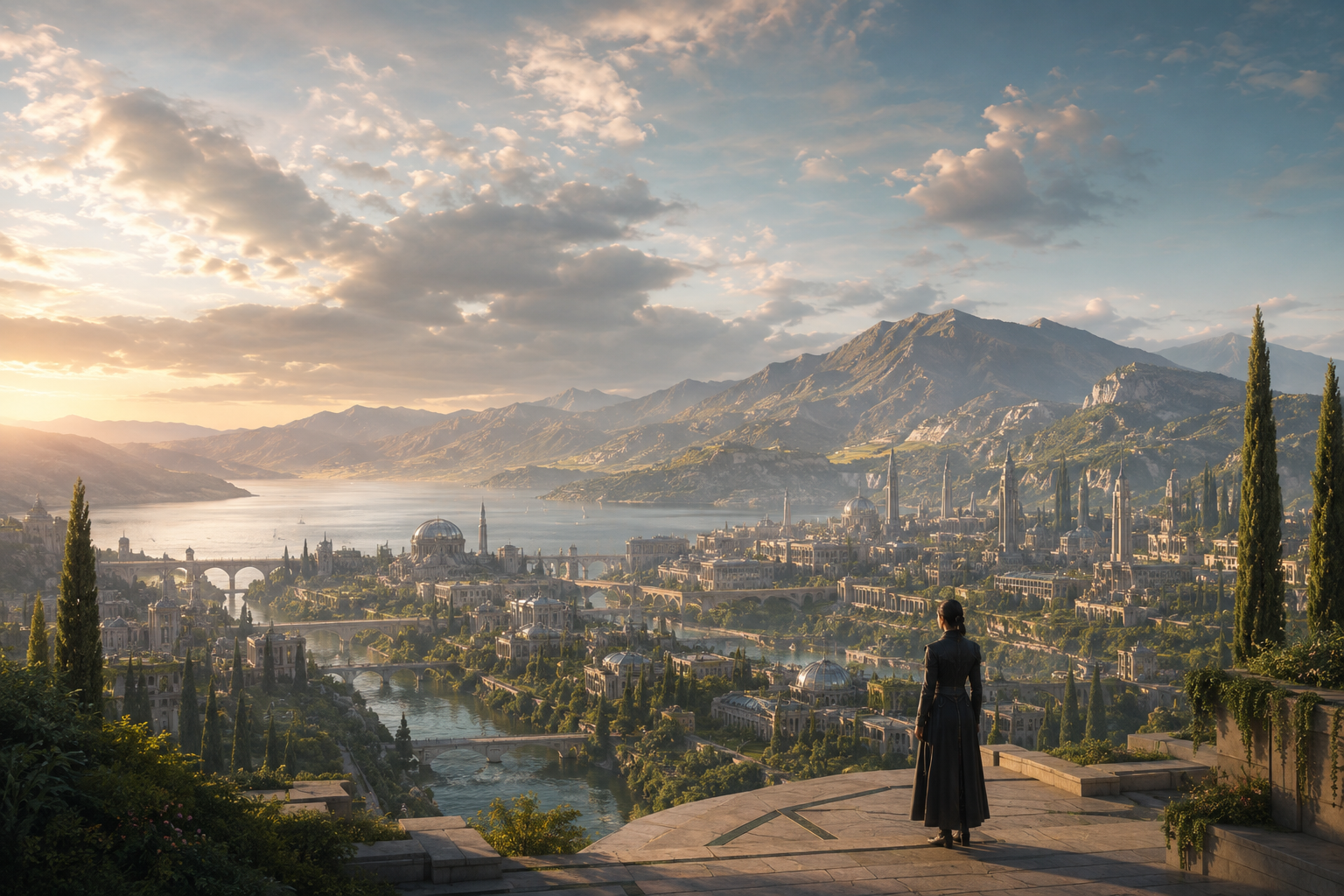
Verdantis / Civic memory
About
The city was not imagined overnight.
It was learned.
Verdantis is the result of generations learning that a city cannot survive by solving one system at the expense of another.
01 — Pressure
The systems began
to collide.
For generations, cities treated housing, transport, energy, water and ecology as separate problems. Growth made the separation increasingly expensive.
Heat accumulated. Journeys lengthened. Water moved farther. Energy demand climbed. Land disappeared beneath infrastructure.
The problem was not simply that cities became larger. It was that their systems stopped cooperating.
02 — Transition
Efficiency was
no longer enough.
The first transformation was conceptual.
Instead of asking how each system could consume less, cities began asking what one system could provide to another.
Waste heat became supply. Stormwater became reserve. Roofs became generators. Buildings became habitat. Transport space became public space.
Infrastructure stopped behaving as a collection of isolated machines.
- Waste heat Supply
- Stormwater Reserve
- Roof Generator
- Building Habitat
- Road Public realm
03 — Foundation
Nothing useful
leaves unused.
By the late transition era, the most successful districts were no longer designed around individual technologies.
They were designed around relationships.
Energy moved between buildings. Water circulated through neighbourhoods. Food production entered the urban fabric. Mobility became shared and autonomous. Architecture became climate infrastructure.
The city itself became the machine. But unlike the machines it replaced, it could grow, adapt and repair.
04 — Verdantis
2189
The city is still learning.
Verdantis is not a finished answer. It is a living agreement between architecture, energy, water, ecology and the people who inhabit it.
Every generation inherits the city. Every generation changes it.
This is not perfection. It is continuity.
- Pressure
- Transition
- Foundation
- Verdantis
The record continues